When setting up sound for an event, one of the easiest details to overlook is how high your speakers are placed. Speaker height directly determines how far sound travels, how evenly the audience hears it, and how clean the mix stays. Even the most expensive speakers won’t perform their best if they’re firing into the ground or directly into the front row of people.
Higher Speakers = Better Distance and Coverage
Mid and high frequencies—speech, vocals, instruments—are directional. Where the speaker points is where the sound goes.
If your speakers are too low, the front row absorbs most of the energy and the back of the space hears very little. Raising speakers above head level allows sound to project over the audience and reach farther distances with cleaner clarity. This maintains consistent volume from the first row all the way to the back without needing to push the system too hard.
Why Floor-Level Speakers Don’t Work (Except Subwoofers)
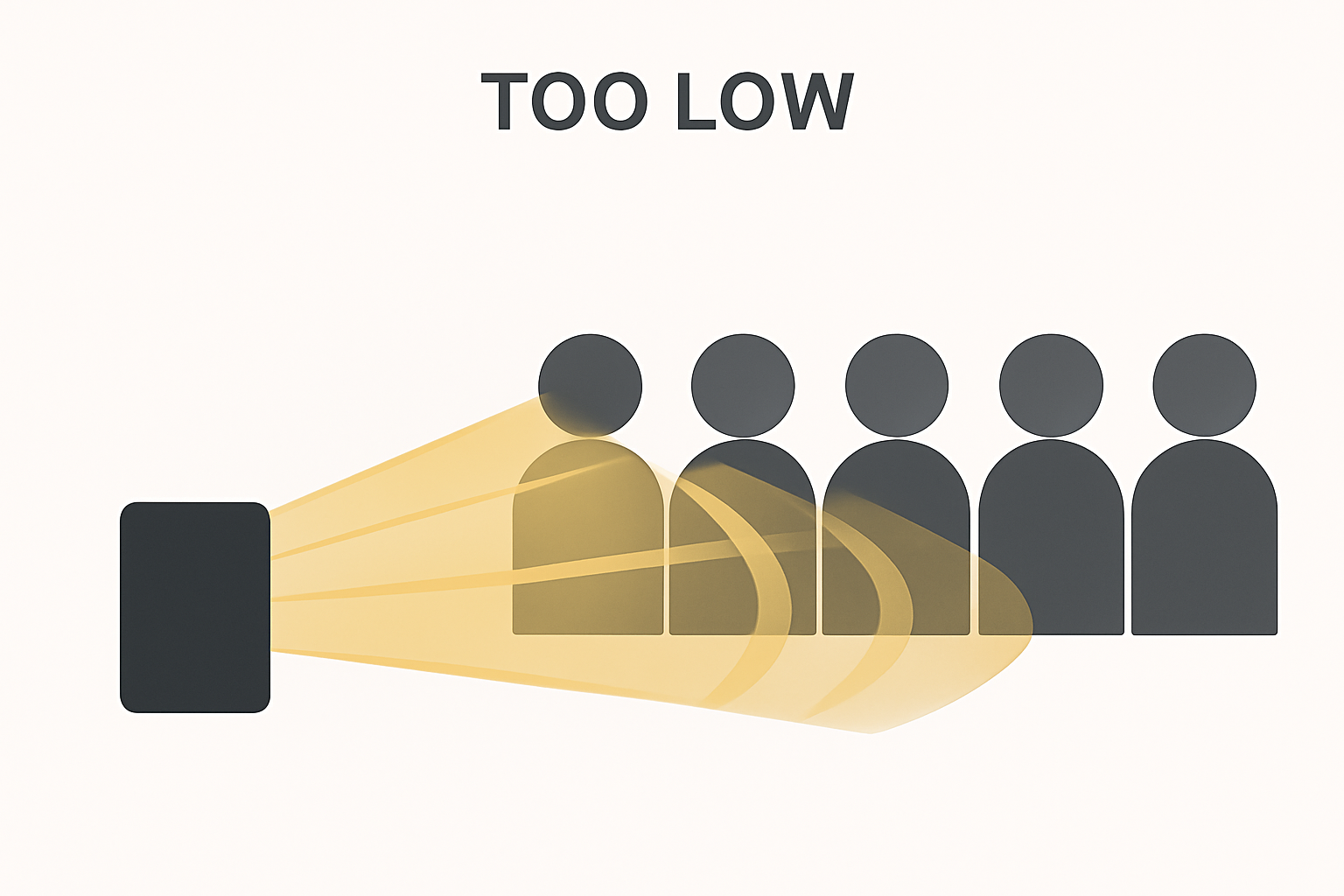
Placing a full-range speaker on the ground is the fastest way to ruin your sound coverage. When full-range speakers sit directly on the floor:
- Most of the energy fires into the ground or people’s knees
- Higher frequencies get blocked almost immediately
- You have to turn the volume up much higher
- The mix becomes uneven and muddy
- Feedback becomes more likely
The first few rows get blasted, yet people 50–100 feet away may still struggle to hear anything clearly.
Raised Speakers Give the Best Results
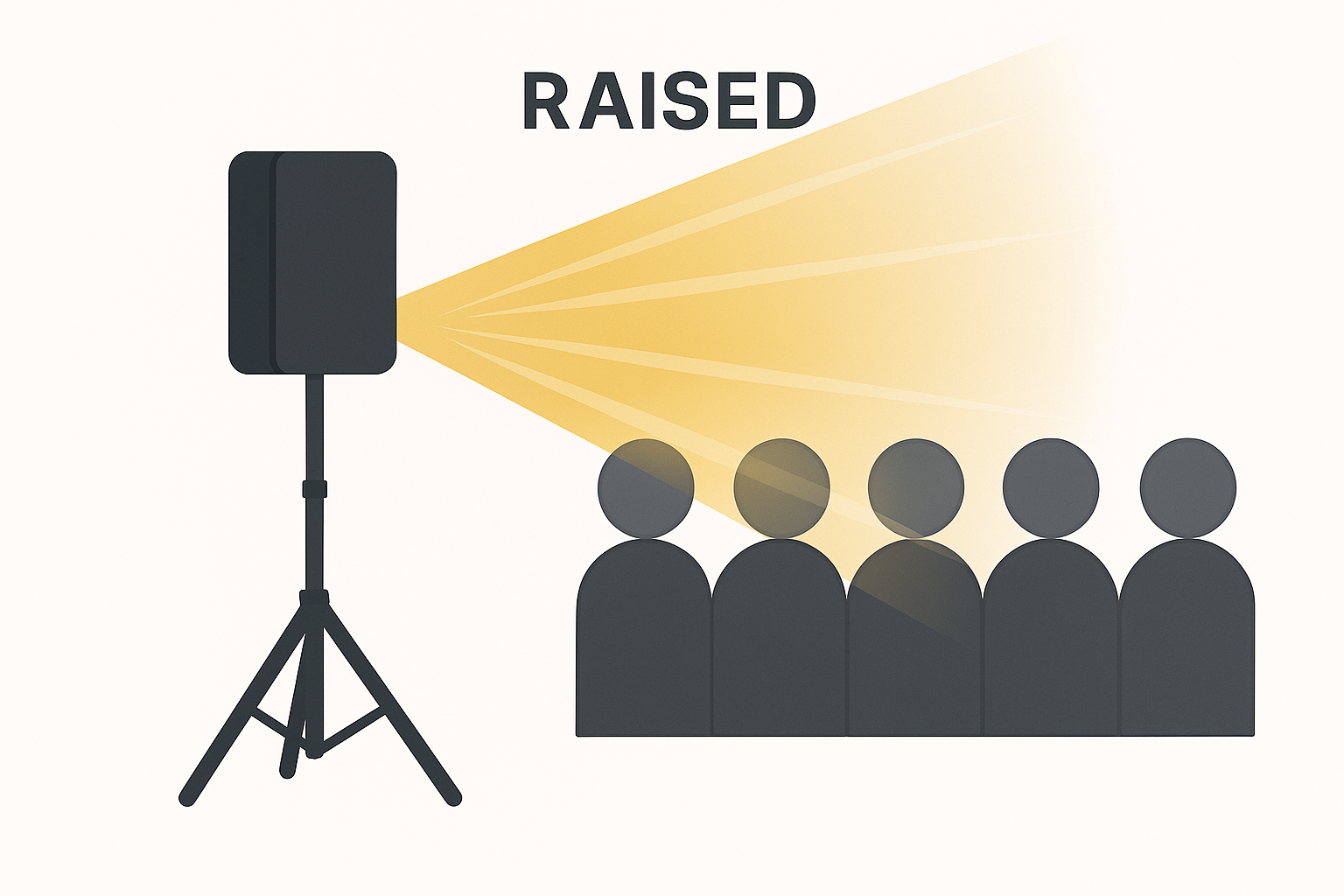
A properly raised speaker—typically 6–7 feet high—projects over the audience, allowing sound to spread evenly. Tilting the speaker slightly downward helps maintain consistent volume from front to back without overpowering anyone.
Raised speakers provide:
- Cleaner sound
- Better distance coverage
- Less distortion
- More even tone
- Lower dB required to cover the same area
Subwoofers Are the Exception
Subwoofers are designed to sit on the floor. Low frequencies travel in all directions and pass through solid objects easily, so raising them offers little benefit.
In fact, subs placed on the floor benefit from boundary coupling, which increases bass output and warmth.
Simple rule:
- Full-range speakers: Raise them.
- Subwoofers: Keep them on the ground.
Real-World Example: 15-Foot Stage With Audience 200 Feet Back
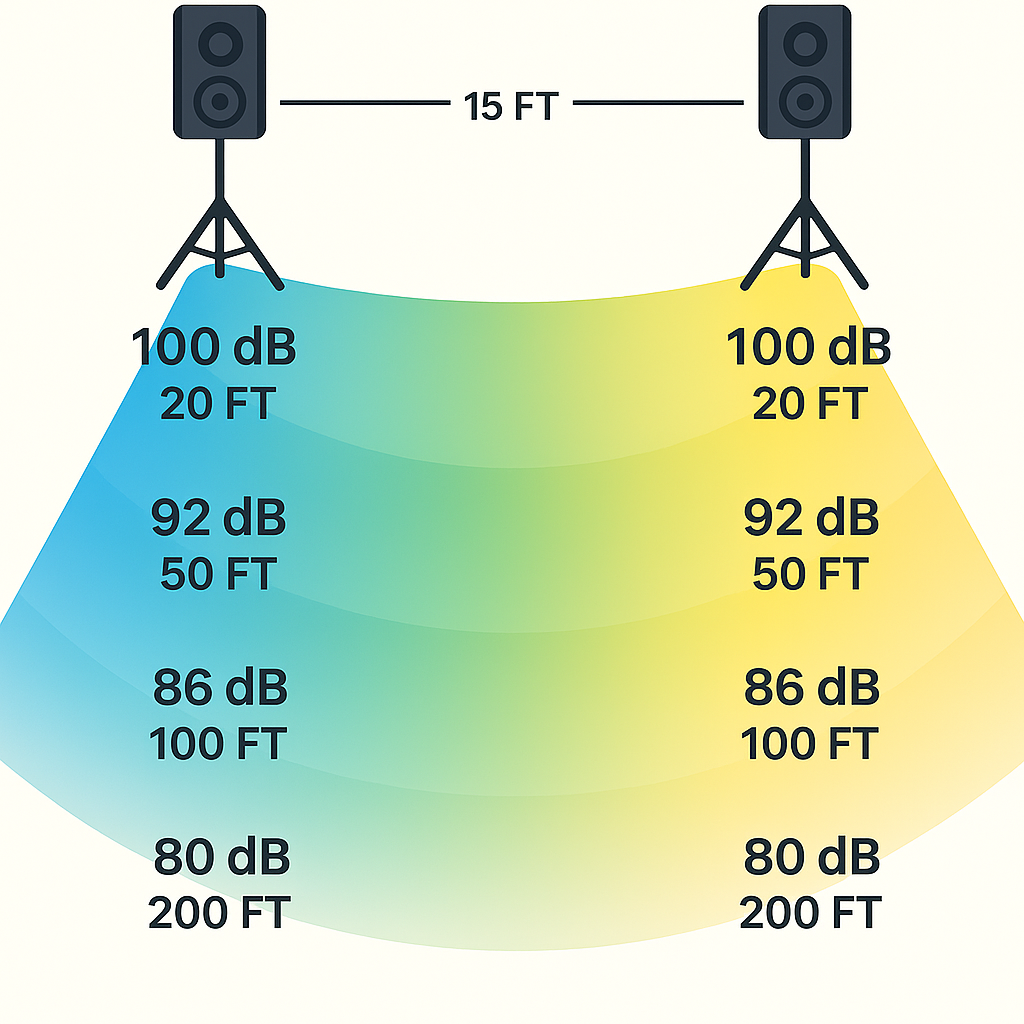
Let’s imagine a stage that is 15 feet wide, with the audience stretching 200 feet back.
If your speakers produce about 100 dB at 20 feet, typical sound falloff looks like:
- 20 ft → ~100 dB
- 50 ft → ~92 dB
- 100 ft → ~86 dB
- 200 ft → ~80 dB
80 dB at 200 feet is still perfectly usable for both speech and music as long as the speakers are raised correctly. If those same speakers were sitting too low, the sound would be absorbed by the first few rows, and the back of the audience would barely hear anything at all.
But What About Weather?
Temperature and moisture in the air can also affect how sound travels:
- Cold air carries sound farther
- Warm air absorbs sound more quickly
- High humidity helps sound travel slightly better
- Very dry air causes higher frequencies to fade sooner
These factors can shift the levels slightly, but generally speaking, the distances and dB levels above are accurate for most real-world events.
Why We Use QSC K12.2 for Larger Events
For larger events—especially outdoor gatherings or long-throw setups—we typically use QSC K12.2 speakers because:
- They offer a 70° horizontal coverage pattern
- They stay clean and undistorted at higher volumes
- They maintain clarity over long distances
- They perform extremely well when elevated
- They work reliably in open-air environments
When properly raised, a pair of K12.2 speakers can deliver clean 80 dB at 200 ft, making them ideal for ceremonies, sports events, town gatherings, concerts, and outdoor stages.
Common dB Levels in Daily Life
Here’s a simple breakdown of everyday decibel levels to help put event audio into perspective:
- 30 dB – Whisper, quiet library
- 50 dB – Light conversation at home
- 60–65 dB – Normal speaking voice
- 70–75 dB – Background music, busier restaurants
- 80 dB – Loud crowd noise, typical level 200 ft from raised PA speakers
- 85–90 dB – Indoor event with amplified speech
- 95–100 dB – Moderate live music
- 110+ dB – Rock concert or nightclub
Understanding these levels helps ensure your event is loud enough to be heard clearly, but still comfortable for your audience.
Real-World Example: Two QSC K12.2 Covering 200 Feet
If you place two QSC K12.2 speakers on a 15-foot-wide stage and raise them properly, they are capable of projecting approximately:
- ~100 dB at 20 feet
- ~92 dB at 50 feet
- ~86 dB at 100 feet
- ~80 dB at 200 feet
This shows why height matters so much—when elevated, the speakers can project clean, usable sound all the way to the back without needing excessive volume.
Links
https://www.sweetwater.com/store/detail/K12.2–qsc-k12.2-2000w-12-inch-powered-speaker
Leave a Reply